
When joint pain, a tendon injury, arthritis, or another musculoskeletal condition keeps you from doing the things you enjoy, finding the right doctor can feel overwhelming. A search for the “best regenerative medicine doctor near me” or “pain management doctor in Portland” may return dozens of clinics, each offering different procedures, technologies, and promises.
How can you tell which provider is right for you?
The best regenerative medicine and pain management doctor is not necessarily the one offering the newest treatment or making the boldest claims. Look for a physician who carefully evaluates the source of your pain, explains all reasonable options, uses appropriate imaging and procedural guidance, and creates a treatment plan around your specific condition and goals.
Here are the most important factors to consider when choosing a regenerative medicine doctor in Lake Oswego, Portland, or the surrounding area.
1. Look for a Doctor Who Identifies the Source of Your Pain
Effective pain treatment begins with an accurate diagnosis. Knee pain, shoulder pain, hip pain, or back pain can have several possible causes, and two patients with pain in the same area may need very different treatment plans.
Your evaluation should include a thorough discussion of:
- Where and when your pain occurs
- How the condition began
- Which activities make it better or worse
- Previous injuries, imaging, or treatments
- Your mobility and functional limitations
- Your goals for work, exercise, sports, and daily life
A regenerative medicine consultation should not feel like a sales presentation for a predetermined procedure. Your doctor should first determine which structures may be contributing to the problem and whether regenerative medicine is appropriate for your condition.
In some cases, a patient may benefit from platelet-rich plasma therapy. Another may be better suited for shockwave therapy, a minimally invasive tendon procedure, physical therapy, or a combination of treatments. A trustworthy pain management doctor should also tell you when a procedure is unlikely to help.
2. Ask About the Doctor’s Regenerative Medicine Experience
Regenerative medicine is a broad term. It may include platelet-rich plasma, commonly called PRP, as well as orthobiologic treatments involving a patient’s own bone marrow or adipose tissue.
When comparing providers, ask:
- What training do you have in regenerative and musculoskeletal medicine?
- How often do you perform these procedures?
- Which conditions do you commonly treat?
- How do you determine whether PRP or cell therapy is appropriate?
- Do you use image guidance when performing injections?
- What results and recovery timeline are realistic for my condition?
Experience matters because regenerative treatment is not simply about preparing an injection. The physician must select the appropriate patient, understand the affected anatomy, choose the proper treatment, and precisely deliver it to the intended structure.
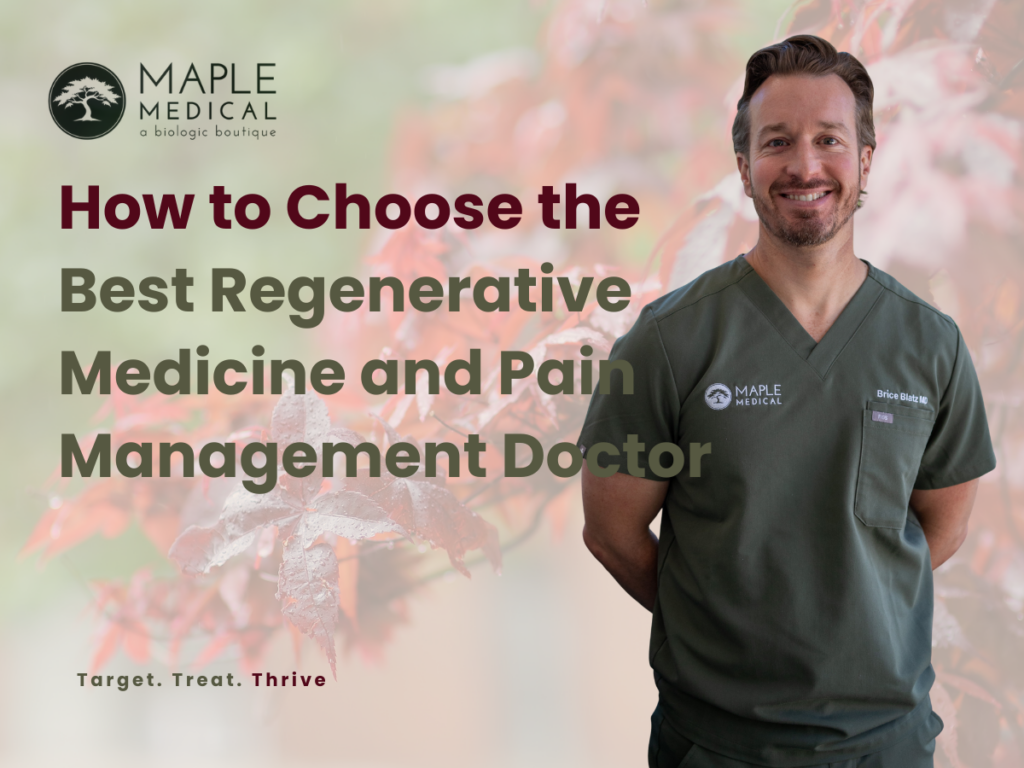
At Maple Medical, Dr. Brice Blatz develops individualized treatment plans using orthobiologic options such as platelet-rich plasma, micro-fragmented adipose tissue and bone marrow aspirate concentrate when clinically appropriate.
3. Choose a Practice That Offers More Than One Treatment
Be cautious when every patient is recommended the same procedure. Musculoskeletal pain can involve joints, tendons, ligaments, muscles, fascia, nerves, or a combination of structures. No single therapy is the right answer for every condition.
A comprehensive regenerative medicine and pain management practice may offer multiple options, such as:
- Platelet-rich plasma therapy
- Bone marrow aspirate concentrate
- Micro-fragmented adipose tissue
- Focused shockwave therapy
- Radial pressure wave therapy
- Extracorporeal magnetotransduction therapy
- Tenex or TenJet for tendon conditions
- Sonex procedures
- Ultrasound-guided injections
- Physical therapy and structured rehabilitation
Access to several treatment options allows the physician to build a plan around the patient instead of trying to fit every patient into one service.
For example, shockwave therapy may be used independently for certain chronic tendon or soft-tissue conditions. In other situations, it may be combined with PRP, EMTT, rehabilitation, or another procedure as part of a broader recovery plan.
4. Ask Whether Procedures Are Ultrasound-Guided
Precision is especially important when treating small joints, tendons, ligaments, and other musculoskeletal structures. Ultrasound guidance allows the physician to view the anatomy in real time and guide a needle or treatment device toward the intended area.
When speaking with a regenerative medicine doctor, ask whether ultrasound is used for evaluation and procedural guidance. You should also ask who performs the procedure and whether the same physician who evaluated you will be involved in your treatment.
Image guidance does not guarantee a particular result, but it can be an important part of accurate, anatomy-based care.
5. Avoid Clinics That Guarantee Results
Patients frequently ask, “Does regenerative medicine really work?” The honest answer is that results depend on the diagnosis, severity of the condition, treatment selected, overall health, rehabilitation, and individual response.
No ethical physician should guarantee that PRP, stem cell therapy, or another regenerative treatment will eliminate pain or prevent surgery. Instead, the doctor should explain:
- Why the treatment may be appropriate
- The available evidence and limitations
- Potential risks and side effects
- Expected recovery and activity restrictions
- When improvement may occur
- What happens if the treatment does not work
- Other reasonable treatment alternatives
Regenerative therapies are generally intended to support the body’s healing response and improve pain or function over time. They should not be presented as an instant cure or a way to regrow an entirely new joint.
6. Understand the Recovery and Rehabilitation Plan
Treatment should not end when the procedure is completed. Depending on the condition, recovery may include temporary activity restrictions, progressive loading, physical therapy, home exercises, and follow-up evaluations.
Ask your doctor:
- How much downtime should I expect?
- When can I return to work?
- When can I exercise again?
- Will I need physical therapy?
- Are there medications or activities I should avoid?
- How will we measure whether the treatment is working?
Some energy-based treatments, including shockwave therapy and EMTT, may require little or no downtime. PRP and cell-based procedures may involve temporary soreness followed by a more gradual return to activity.
A well-designed rehabilitation plan can help restore mobility, rebuild strength, and support the treated area as you return to normal activities.
7. Consider Communication, Transparency, and Follow-Up Care
The best pain management doctor should make you feel informed rather than pressured. The practice should clearly communicate appointment instructions, expected costs, treatment steps, and follow-up recommendations.
Before moving forward, make sure you understand:
- The total expected cost
- Whether treatment is covered by insurance
- How many sessions may be recommended
- What is included in the treatment price
- Whether follow-up visits are included
- Who to contact with questions after treatment
Many regenerative medicine procedures are not covered by insurance, so transparent pricing is particularly important. You should receive enough information to make an informed decision without being rushed into purchasing a treatment package.
Find a Regenerative Medicine Doctor in Lake Oswego
Maple Medical provides personalized regenerative medicine and non-surgical pain care in Lake Oswego, Oregon, serving patients from Portland and throughout the surrounding area.
Dr. Brice Blatz evaluates each patient individually and may incorporate treatments such as PRP therapy, MFAT, BMAC, focused or radial shockwave therapy, EMTT, Tenex, TenJet, Sonex, and ultrasound-guided procedures when appropriate.
The goal is not simply to cover up pain. It is to understand the condition, identify appropriate treatment options, and create a coordinated plan focused on improving mobility, function, and quality of life.
Are you searching for a regenerative medicine doctor near Portland or exploring non-surgical treatment for joint pain, arthritis, or a tendon injury? Contact Maple Medical in Lake Oswego to schedule a consultation and learn which options may be appropriate for you.


