
If you are considering Shockwave Therapy, you may wonder how many appointments you will need and how treatment will fit around work, exercise, and everyday life.
There is no single session count for every patient. Your diagnosis, the tissue being treated, previous care, treatment method, and response all help shape the recommendation.
At Maple Medical in Lake Oswego, we begin with an evaluation and build a plan around your needs. Our Shocktober packages offer four or six Shockwave sessions, but those package sizes do not determine how many visits are clinically appropriate for you.
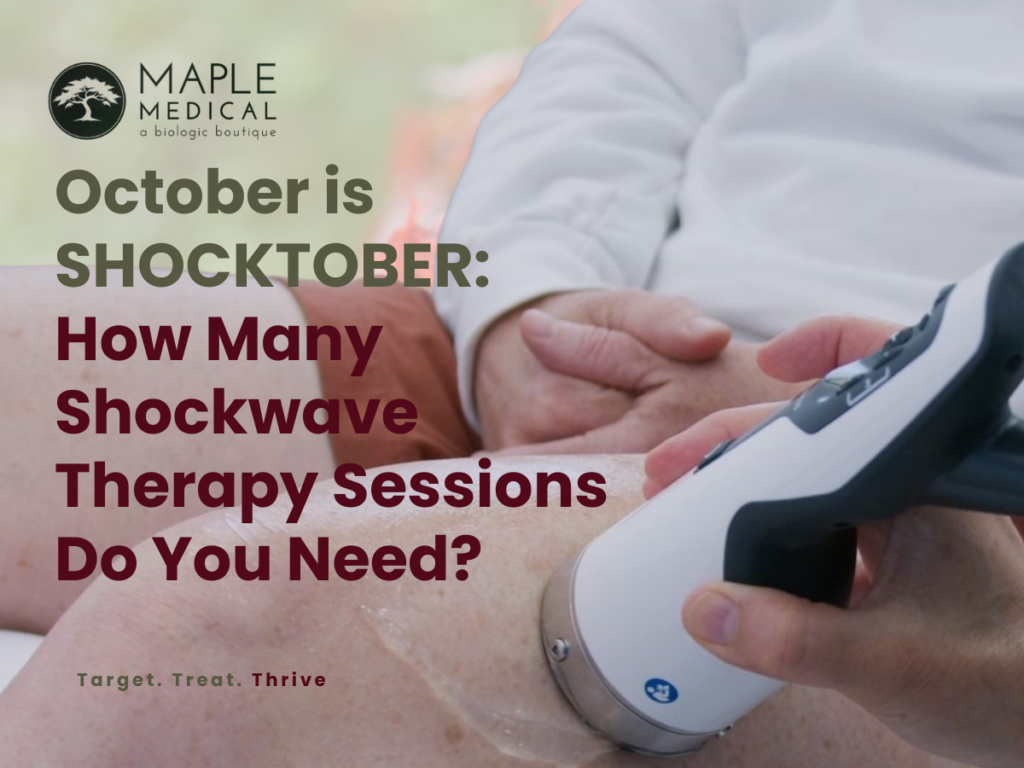
Why Is Shockwave Therapy Often Planned as a Series?
Shockwave Therapy delivers acoustic energy to a targeted area. It may be considered for certain tendon, plantar fascia, and other musculoskeletal concerns as part of a broader care plan.
When a series is recommended, appointments give us opportunities to assess symptoms, review function, and decide whether the approach remains appropriate.
Published protocols vary. For example, some tendon-treatment protocols describe three to five visits spaced one to two weeks apart. These are examples of condition-specific approaches, not a universal schedule or a statement of Maple Medical’s protocol.
The goal is to choose a reasonable plan and reassess it. More appointments do not automatically mean better results, and needing additional visits does not necessarily mean your condition is more severe.
What Determines the Recommended Number of Sessions?
Dr. Brice Blatz and the Maple Medical team consider several factors before recommending a treatment series.
Your Diagnosis and the Tissue Involved
Similar symptoms can have different causes. Heel pain, for example, should be evaluated before assuming the plantar fascia is the source.
The affected structure, its location, and examination findings help determine whether Shockwave Therapy may be appropriate. They also help guide the treatment method and starting plan.
How Long Symptoms Have Been Present
A recent concern may need a different approach from symptoms that have persisted or repeatedly returned despite previous care.
We consider how the problem affects walking, work, exercise, sleep, and daily movement. Your history helps us understand what has changed and what you hope to regain.
Previous Care and Your Current Plan
Tell us about physical therapy, medication, injections, footwear changes, activity modification, or procedures you have already tried.
This information helps us avoid treating the concern in isolation. Your plan may also include strengthening, mobility work, physical therapy coordination, or guidance about gradually returning to activity.
The Treatment Method
Focused Shockwave Therapy and radial pressure wave therapy deliver energy differently. Focused treatment can target structures at a selected depth, while radial pressure waves generally act more superficially.
The appropriate method depends on your anatomy, diagnosis, examination findings, and goals. A plan may involve one approach or a combination when clinically appropriate.
Your Response to Treatment
The initial recommendation provides a starting point. During follow-up, we may review symptoms, tenderness, strength, activity tolerance, or other measures relevant to your condition.
Progress may not be immediate or consistent from visit to visit. Limited improvement, unexpected reactions, or changing symptoms can prompt a reassessment rather than simply adding appointments.
Your Activity Goals
Walking comfortably, returning to gardening, and preparing for a sport can involve different demands.
Explain what you want to do and what currently limits you. Those details help us define useful measures of progress and discuss activity adjustments during treatment.
How Are Visits Spaced, and What Happens Between Them?
The interval between appointments is part of your treatment plan. Some condition-specific tendon protocols use one- to two-week intervals, but the timing depends on the diagnosis, treatment approach, and clinical recommendation.
We will explain your proposed schedule and any activity guidance. Some patients may continue modified activity, while others may need to reduce activities that overload the affected area.
Between visits, useful observations include:
- Changes in walking or everyday movement
- How long you can perform an activity before symptoms begin
- Changes in stiffness, tenderness, or mobility
- Any unexpected reaction following treatment
Share these observations with us. They help us decide whether to continue, modify, pause, or complete the planned series.
Before your first appointment, ask what the proposed series includes, when progress will be reviewed, and what would lead us to change the plan. Knowing those details can help you plan appointments and raise questions about your care. Feeling better after one visit does not establish that treatment is complete, just as continued discomfort does not automatically mean more sessions are needed.
When Might EMTT Be Included?
EMTT stands for electromagnetic transduction therapy. It uses electromagnetic energy, while Shockwave Therapy uses acoustic energy. They are separate treatments.
For some patients, Shockwave Therapy may be considered on its own. For others, we may include EMTT and shockwave therapy within a coordinated plan.
The decision depends on the condition, tissue involved, previous care, and clinical evaluation. Dr. Blatz determines whether EMTT is appropriate for your individual needs.
An offer that includes EMTT does not make it necessary for every patient. We can explain why it is being considered and how it would fit into your care.
Can Shockwave Therapy Be Part of a Maintenance Plan?
Follow-up discussions can extend beyond a current pain flare. For selected active patients with an evaluated musculoskeletal concern, periodic treatment may be considered within an individualized treatment plan.
The goal may be to support joint, tendon, and soft tissue function while helping you continue activities you enjoy. Whether additional treatment is appropriate depends on your condition, previous response, current needs, and clinical evaluation.
Being active alone is not a reason to receive Shockwave Therapy on a fixed schedule. Maintenance should not be presented as routine injury prevention or a promise of improved athletic performance.
New or changing symptoms also deserve reassessment. Similar discomfort can have a different cause, and repeating a previous treatment may not be the right next step.
How Shockwave Therapy Fits Into a Complete Care Plan
Appointments are only one part of managing a musculoskeletal concern. Strength, mobility, activity demands, footwear, and rehabilitation may also need attention.
For example, care for tendon injuries may include gradually rebuilding tolerance for activity. Someone with plantar fasciitis may also need guidance about footwear, exercises, and daily loading.
We take a condition-first approach. Understanding what contributes to the problem helps us discuss treatment options and the support that may be useful between visits.
October Is Shocktober at Maple Medical
If Shockwave Therapy is appropriate for your needs, our October promotion offers savings on two treatment packages.
Save up to $1,370 with Shockwave Therapy and EMTT included when clinically appropriate.
Choose your Shocktober package:
- Buy 4, Get 2 Free: Six Shockwave sessions for the price of four.
- Buy 3, Get 1 Free: Four Shockwave sessions for the price of three.
- EMTT included when clinically appropriate: Its use depends on your individual evaluation and treatment recommendation.
Depending on the package selected, patients can save between $770 and $1,370.
Contact our team to learn which package may be appropriate for your needs. The recommended number of sessions should follow your clinical plan.
Offer valid through October 31, 2026.
Frequently Asked Questions
Is One Shockwave Therapy Session Enough?
It depends on the condition and treatment plan. A change after one appointment does not establish that no further care is needed. Your clinician will explain the proposed series and when progress should be reviewed.
How Far Apart Are Shockwave Therapy Sessions?
Some tendon-treatment protocols use one- to two-week intervals. Your schedule may differ based on the diagnosis, treatment method, response, and broader care plan. We will explain the recommended timing for your treatment.
Is EMTT Included With Both Shocktober Packages?
Yes, EMTT is included with either promotional package when clinically appropriate. Dr. Blatz determines whether it belongs in your plan; inclusion in the offer does not mean every patient should receive it.
Can I Exercise During a Shockwave Therapy Series?
Activity recommendations depend on your condition and planned treatment. You may be advised to modify certain activities or reduce loading temporarily. Follow your care team’s instructions and report unexpected changes.
Does Every Active Patient Need Maintenance Treatment?
No. Periodic treatment may be considered for selected patients with an evaluated concern and a clinical reason for follow-up. Activity level alone does not establish a need for maintenance sessions.
Start With an Individualized Evaluation
The answer to “How many Shockwave Therapy sessions do I need?” starts with understanding your condition and goals. The recommended plan should account for what is being treated, previous care, and how progress will be assessed.
At Maple Medical, we serve Lake Oswego, Portland, and nearby communities with personalized musculoskeletal care. We can explain your options, discuss whether EMTT may be appropriate, and review the available Shocktober packages.
Request a consultation to discuss your needs and next steps.


