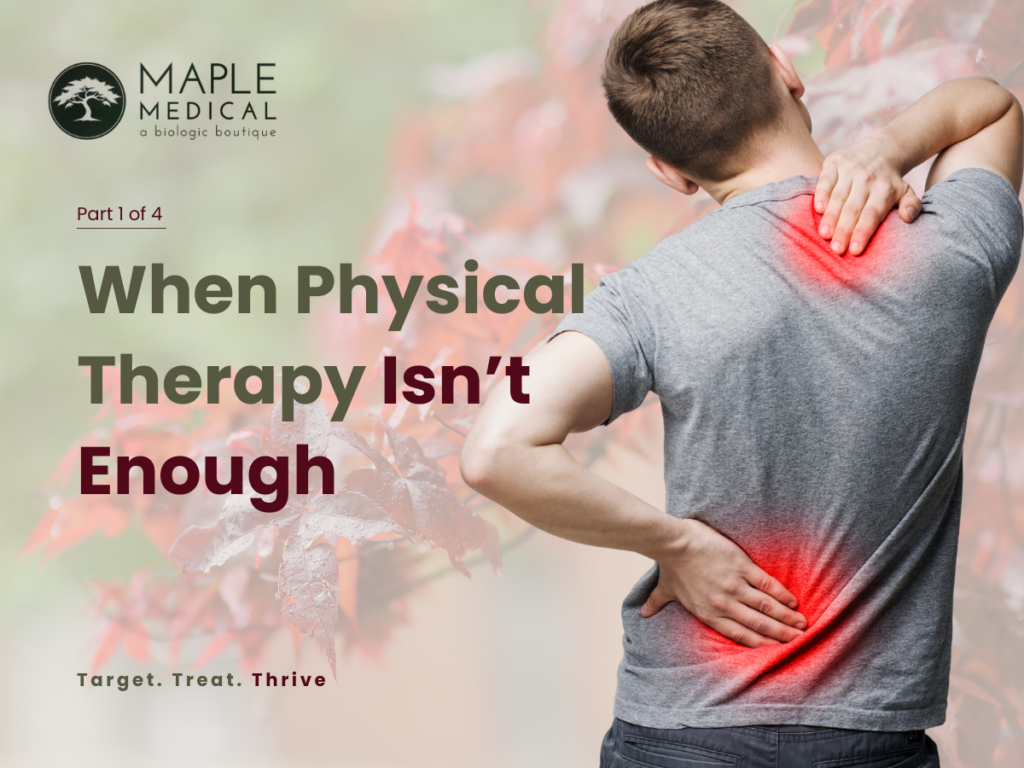
You’ve done the home exercises. You’ve shown up to every session, stayed consistent, and put in the work. Yet, despite your best efforts, you’ve hit a wall—the pain lingers, the range of motion won’t budge, and frustration sets in. When physical therapy stalls, conventional wisdom often drops a heavy ultimatum: if rehab didn’t fix it, surgery must be your only option left. That is a myth.
The truth is, physical therapy provides the mechanical roadmap for recovery, but sometimes the target tissue simply lacks the biological resources to heal itself. When tendons, ligaments, or joint cartilage are starved of key cellular signaling, even the best exercise program can’t bridge the gap alone. This is where physical therapy and the regenerative medicine team at Maple Medical join forces. By pairing targeted biomechanical rehab with cutting-edge cellular therapies, we can reboot your body’s natural healing cascade—giving your tissue the biological jumpstart it needs so physical therapy can finally finish the job.
This article is part of a collaborative effort between Maple Medical and MovementX Physical Therapy, bringing together expertise in medical care, rehabilitation, and movement to provide patients with well-rounded health and wellness information.
The Gold Standard: Physical Therapy
Physical therapy remains the undisputed gold standard for movement-related pain for one simple reason: your body relies heavily on mechanical stress to drive recovery. At its core, active rehabilitation works because targeted biomechanics and controlled tissue loading directly stimulate collagen synthesis, which is the foundational biological process required to rebuild tendons, ligaments, and cartilage. By systematically improving muscle recruitment, therapy re-educates the body on how to distribute force properly, ensuring the right muscle groups fire at the right time to absorb shock and protect vulnerable joints.
Like all good things, this biological rebuild requires time. True strength gains and tissue remodeling do not happen overnight; the first few weeks of therapy are primarily dedicated to neurological adaptations, as your brain learns to recruit muscle fibers more efficiently. After that, actual structural tissue changes occur, and around 12 weeks, muscle fibers can increase in size, strength, and tendons can improve their load capacity. A trustworthy pain management doctor should also tell you when a procedure is unlikely to help.
Why Do Some Patients Plateau?
Many people reach a point where they are doing all the right exercises, working with an excellent physical therapist, and still aren’t making meaningful progress. At that stage, the limiting factor often isn’t effort—it’s tissue biology.
Certain structures simply have poor natural healing capacity. Tendons receive very little blood flow, cartilage has virtually no direct blood supply, and chronic inflammation can alter the environment inside a joint, making it difficult for healthy repair to occur. Even partial tendon or ligament tears may remain mechanically weak despite months of strengthening. While physical therapy improves how these tissues function, regenerative medicine focuses on optimizing the biological environment, so damaged tissues can better respond to rehabilitation.
Using high-resolution diagnostic ultrasound, we identify the exact structure responsible for a patient’s symptoms. When appropriate, treatments such as Platelet-Rich Plasma (PRP), autologous cell therapy (like your own fat or bone marrow), Shockwave Therapy, or EMTT may be recommended to support tissue remodeling and create a more favorable environment for recovery.
The goal isn’t to replace physical therapy—it’s to help patients get more out of it. appropriate.
The Collaboration: Synergistic Healing
Think of recovery like growing a healthy plant: the soil provides the foundation, sunlight provides energy, and cultivation directs growth. Regenerative medicine prepares the “soil”, creating a healthier biological environment for damaged tissues. Shockwave Therapy and EMTT provide “sunlight”, delivering mechanical and electromagnetic energy that stimulates cellular activity and supports tissue remodeling. Physical therapy provides “cultivation”, using progressive loading and movement retraining to help those tissues become stronger and more resilient.
Sunlight without cultivation won’t produce a healthy plant. Likewise, regenerative medicine, energy medicine, and physical therapy each contribute — together they give patients the best opportunity for lasting recovery.
Recovery isn’t about choosing one approach over another. It’s about bringing biology, energy, and movement together.
“Is Your Recovery Stuck?” Checklist
Check off any statements that apply to your current recovery:
- Looking Beyond Surgery/Cortisone: You want to repair tissue non-surgically rather than just mask pain.
- No Change at 6–8 Weeks: You’ve been consistent with targeted PT, but pain or function hasn’t improved.
- Exercises Trigger Flare-Ups: Progressive loading consistently causes pain rather than building tolerance.
- Structural Bottlenecks on Imaging: MRI/ultrasound shows chronic tendinosis, partial tears, or joint degeneration.
- The Early Plateau: You made initial progress, but gains completely stalled before reaching your goals.
Your Next Steps
- 0–1 Checks: Stick with PT. Neurological adaptation and tissue remodeling take time.
- 2+ Checks: Consider a joint evaluation. Your tissue may need a biological “spark” (like PRP or shockwave therapy) to break through the plateau so rehab can work.
The best recovery plans don’t choose between biology and movement—they bring them together. This is why regenerative medicine can amplify the effects of physical therapy and help get you past that dreaded plateau. joint.


